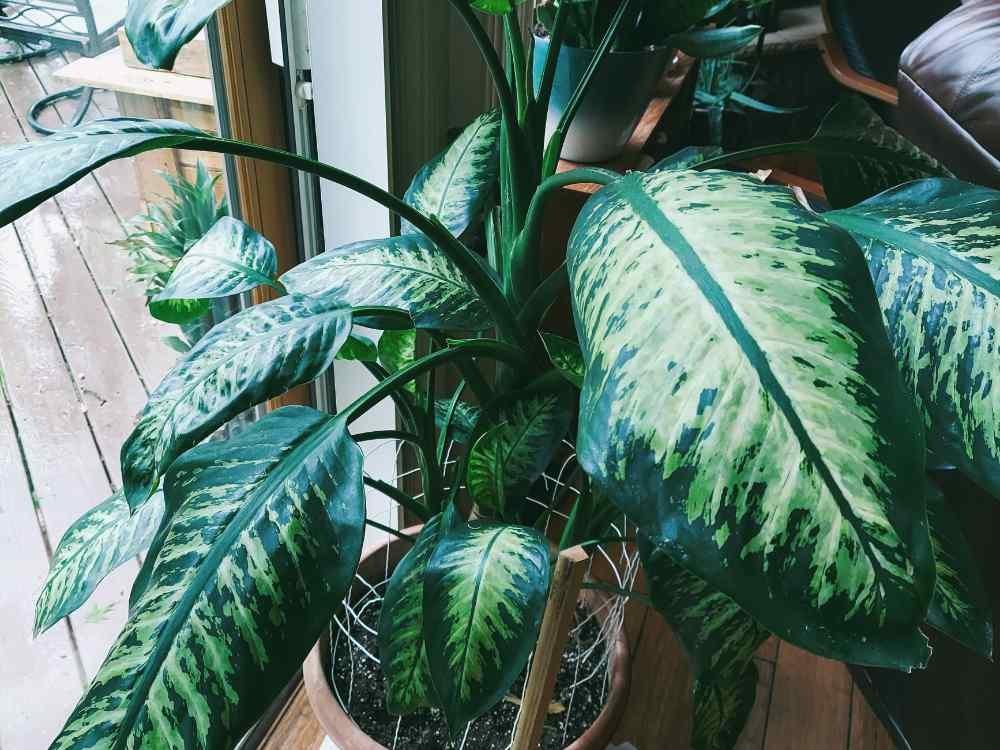
Dieffenbachia plants are beloved indoor houseplants prized for their broad foliage and striking variegated patterns. In the right indoor environment, these tropical beauties can expand rapidly and quickly outgrow their designated space.
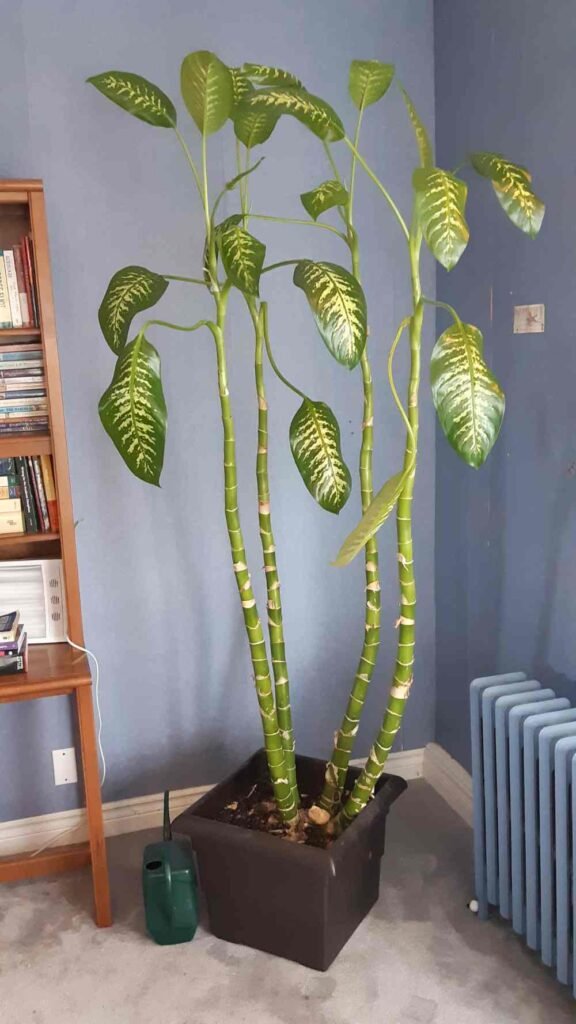
When a dumb cane becomes too tall, it often drops its lower leaves, develops a bare cane, and begins to lean precariously.
You do not need to discard an oversized plant, because pruning and propagation can easily restore its compact shape while creating brand new plants.
Understanding the Dieffenbachia Plant
Dieffenbachia, commonly referred to as dumb cane, is native to the tropical regions of Central and South America. In its natural rainforest habitat, it thrives beneath dense forest canopies where humidity remains high and sunlight is gently filtered.
As an indoor houseplant, it adapts remarkably well to average home temperatures and moderate humidity levels. It produces thick, fleshy stems that store water and nutrients, supporting lush clusters of large patterned leaves.
Understanding the natural growth cycle of this tropical perennial helps you manage its height. As new growth emerges from the crown, older foliage naturally matures and falls away, slowly turning the plant into a miniature indoor tree over time.
How Big Can Dumb Cane Plants Grow
In outdoor tropical climates, some Dieffenbachia species can reach heights of ten feet or more with expansive leaf spreads. When kept indoors in containers, most varieties will max out between four and six feet tall.
Certain cultivars remain naturally compact, while popular varieties like Dieffenbachia seguine or Tropic Snow have the genetic drive to grow quite large. If given optimal warmth and food, they can add several feet of growth in a single growing season.
When these plants reach five or six feet indoors, their top-heavy canes frequently begin to bend. Stems that grow too tall without sufficient base support will often curve toward the light source or snap under their own weight.
Reasons Your Dieffenbachia Is Growing Too Tall
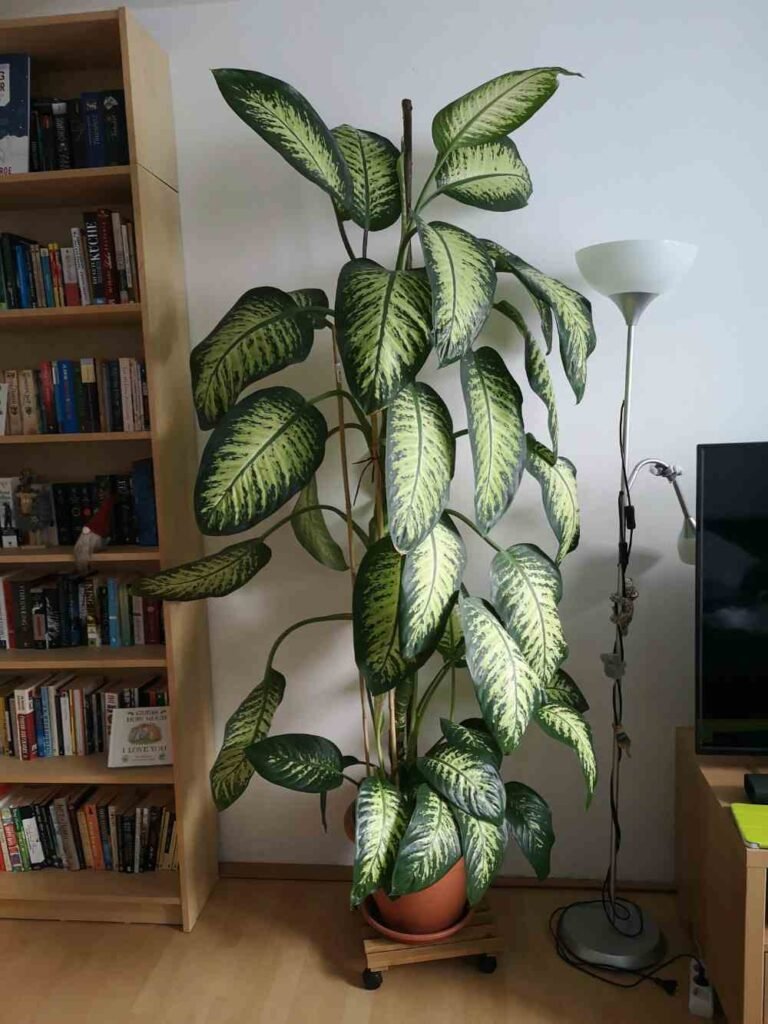
While natural vigor plays a significant role in plant height, rapid and awkward upward growth is often a symptom of environmental conditions. Indoor plants adjust their stems based on the resources available in their surroundings.
When the balance between light, pot volume, and nutrients is slightly off, the plant responds by altering its growth habit. Identifying the exact trigger behind the surge in height will help you fix the underlying cause after pruning.
Insufficient Light and Leggy Growth
The most frequent cause of an overly tall dumb cane is inadequate lighting. In low-light corners, the plant stretches its stems toward the nearest window in a process known as etiolation.
This stretching results in long gaps between the leaf nodes, producing weak and spindly canes. Instead of dense foliage, you end up with thin stems that struggle to hold up the top leaves.
Providing generous bright, indirect light ensures the plant produces tight internodes. This keeps the foliage full, lush, and clustered near the base.
Pot Size and Root Expansion
The container you choose plays a massive role in regulating the ultimate size of your houseplant. Moving a dumb cane into an oversized pot gives the root system unrestricted room to expand.
When roots spread out in a large volume of potting mix, the plant responds with vigorous vegetative growth above the soil line. If you keep the plant in a moderately snug container, you naturally limit its vertical trajectory.
Restricting the root ball slightly encourages the plant to maintain a bushy shape rather than shooting toward the ceiling.
Natural Growth Habits Over Time
Even under ideal light and potting conditions, maturity will inevitably change the appearance of your plant. A healthy Dieffenbachia continuously pushes new foliage from the central apical shoot.
As new leaves unfurl at the summit, the oldest lower leaves complete their life cycle, turn yellow, and detach. Over a period of several years, this process leaves a substantial length of bare, woody cane at the base.
This structural transformation is completely normal. Pruning is simply the mechanical reset button that stimulates lower buds to break dormancy and create fresh foliage near the soil.
Signs Your Plant Needs Pruning
Deciding when to cut back your dumb cane is straightforward once you know what visual clues to look for. You should intervene before the stems become unstable or touch the ceiling.
Watch for these common indicators that pruning is overdue:
- The stem has bent sideways or requires heavy staking to remain upright.
- The bottom twelve to eighteen inches of the cane are completely bare of foliage.
- The plant has outgrown its dedicated space and blocks doorways or windows.
- The top foliage is sparse and pale due to excessive stem elongation.
- The container tips over easily because the upper canopy has become too heavy.
Safety Precautions Before You Begin
Dieffenbachia earned the nickname dumb cane because its sap contains microscopic needle-shaped calcium oxalate crystals known as raphides. If the sap touches your mouth or vocal cords, it can cause severe swelling, burning, and temporary loss of speech.
Direct contact with skin can cause intense itching, redness, and localized dermatitis. You must take sensible safety measures whenever you cut into the plant tissue.
Always wear thick waterproof gardening gloves when pruning or propagating. Keep curious pets and young children out of the workspace, and never touch your face or eyes while handling freshly cut stems.
Essential Tools and Disinfection
Clean cuts heal quickly and resist fungal or bacterial infection. Before making any incisions, gather the proper cutting implements and hygiene supplies.
Thick canes require bypass pruning shears or a fine-toothed pruning saw rather than household scissors. Household scissors crush plant vascular tissue, which delays recovery and impairs root generation on cuttings.
Disinfect your cutting blades thoroughly before making your first cut. You can wipe the metal with a solution of nine parts water to one part household bleach, or use seventy percent isopropyl alcohol. Allow the blades to dry completely before touching the stems.
Step by Step Guide to Pruning Dieffenbachia
Pruning a large houseplant can feel intimidating, but dumb canes are resilient and recover with great vigor. The goal is to reduce overall height while leaving active growth points behind.
Plan your cuts before you pick up the shears. Decide how tall you want the finished mother plant to be, keeping in mind that new foliage will sprout directly below your cut point.
Work slowly and methodically, making smooth slices through the cane so the remaining stump has the best possible conditions to heal.
Making Clean Cuts Above Growth Nodes
Examine the bare stem to locate the growth nodes. Nodes appear as horizontal rings or bands encircling the green or tan cane, marking the spots where latent buds are situated.
Position your shears roughly one quarter to one half inch above a prominent node. Make your cut at a forty-five degree angle so any ambient moisture drains away from the cut surface instead of pooling on top.
You can reduce the cane down to within four to six inches above the soil line if you want a complete reset. The dormant nodes on the remaining stump will activate within a few weeks and produce fresh shoots.
Removing Discolored and Damaged Foliage
After trimming the main canes down to your desired height, turn your attention to the remaining foliage. Cut away any yellowed, torn, or pest-damaged leaves flush with the main stem.
Removing declining foliage stops the plant from expending vital energy on dying tissue. It also opens up the interior structure to better airflow, reducing the chance of fungal issues.
Collect all trimmings and fallen leaf litter and discard them in the trash. Do not leave discarded leaves on the soil surface, where they can host pests or mold.
How to Propagate the Cuttings
Do not throw away the long canes you removed during pruning. Every healthy section of stem contains dormant buds capable of producing an entirely new root system and canopy.
You can divide a single long cane into multiple cuttings. The top crown with intact leaves makes an instant bushy plant, while bare middle sections of the stem can be rooted as horizontal logs or vertical cane cuttings.
Ensure that every cutting you intend to propagate has at least two or three nodes. Allow the cut ends to dry on a piece of cardboard for two to four hours before planting so a protective callus can form.
Rooting Stem Cuttings in Water or Soil
You can root Dieffenbachia cuttings in water or directly in a lightweight, well-draining potting medium. Both methods deliver dependable success when kept in a warm environment.
For water rooting, place the leafy tip cutting into a clean jar of filtered water, ensuring no leaves touch the liquid. Change the water weekly to maintain high oxygen levels, and transplant into soil when the new roots reach two inches in length.
For soil rooting, insert vertical cuttings upright into a moist blend of peat moss and perlite. For bare canes, you can press them horizontally into the soil mix with the growth buds facing upward. Keep the medium lightly damp and place the tray in bright, indirect light.
Post Pruning Care for the Parent Plant
Once you have finished pruning, the mother plant will enter a brief period of shock and recovery. Because it now possesses fewer leaves, its water consumption will decrease dramatically.
Reduce your watering frequency immediately following a heavy prune. Only apply water when the top two inches of potting soil feel completely dry to the touch, preventing root rot while the plant has limited foliage.
Keep the plant in a bright room with temperatures between sixty-five and seventy-five degrees Fahrenheit. Withhold chemical fertilizers until you see active new green shoots pushing outward from the nodes.
Preventing Leggy Growth in the Future
Maintaining a compact, bushy habit requires consistent environmental management. Once your pruned plant begins to regrow, adjust its living conditions to prevent the same leggy stretching from happening again.
Here are practical ways to maintain dense foliage over the long haul:
- Relocate the plant within three to five feet of an east-facing or filtered south-facing window.
- Rotate the container a quarter turn every time you water so all sides receive balanced light.
- Pinch out the central growth tips occasionally during spring to stimulate side branching.
- Avoid using high-nitrogen synthetic fertilizers that trigger sudden, weak vertical spurts.
- Repot only when the root system has filled the container, stepping up just one pot size.
Common Mistakes to Avoid
Pruning dumb cane is straightforward, but a few frequent errors can slow down recovery or harm the plant. Knowing what to avoid will guarantee the best outcome for your greenery.
Never prune your plant during the depth of winter dormancy unless the stem has broken accidentally. Pruning in early spring or early summer aligns with the natural surge of plant growth hormones, resulting in much faster shoot development.
Avoid overwatering the cut stump. Without a full crown of leaves to transpire water, damp soil stays saturated for too long and can suffocate the root system.
Finally, always remember to wear protective gear. Skipping gloves is a common mistake that often leads to painful skin irritation from the plant sap.
Does Your Dieffenbachia Need a Major Prune?
Answer 4 quick questions to see your result