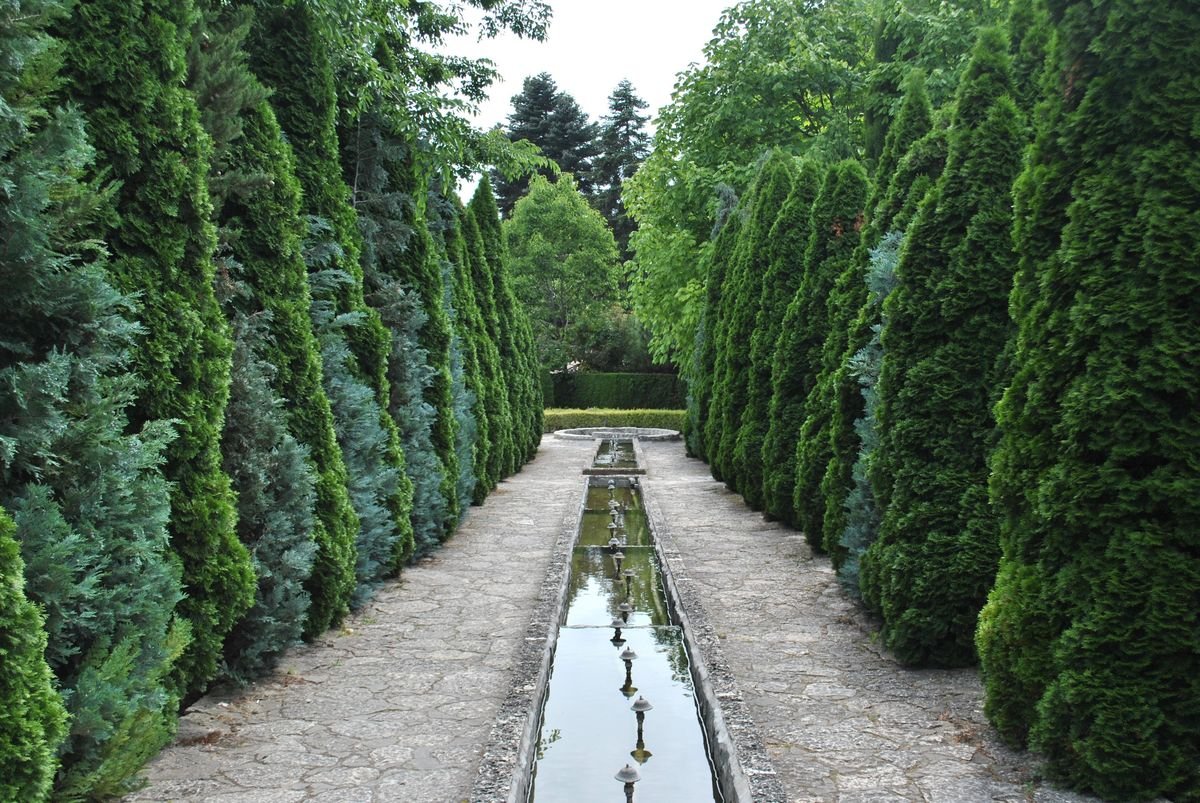
Arborvitae trees remain one of the most popular choices for home landscaping, windbreaks, and privacy hedges. Their dense, vibrant foliage provides year-round color and a dependable acoustic screen that softens neighborhood noise. Many gardeners invest significant time and money planting long rows of these evergreens, only to discover that local wildlife view them as an easy winter food source.
While most common arborvitae varieties are considered candy for foraging deer, specific cultivars and hybrid varieties show remarkable resistance. Understanding the biological differences between arborvitae species, learning how deer feed, and implementing layered protection strategies will help you maintain lush, intact evergreens regardless of local deer pressure.
Why Deer Target Arborvitae Trees
Deer are selective browsers that constantly balance nutrition against energy expenditure. During spring and summer, lush herbaceous perennials, agricultural crops, tender grasses, and broadleaf plants provide ample food across natural habitats.
When autumn transitions into winter, these preferred food sources disappear under snow or go completely dormant. Evergreen foliage becomes one of the few green, nutritious food reserves remaining in the landscape.
Arborvitae foliage contains digestible carbohydrates, vital moisture, and essential minerals that deer need during cold winter months. Because arborvitae trees retain soft, scale-like leaves rather than sharp, stiff needles like spruces, deer can consume large quantities quickly without irritating their mouths.
Residential yards offer an attractive environment for foraging deer because human neighborhoods frequently have fewer natural predators, reduced hunting pressure, and milder microclimates compared to open woodlands.
Most Vulnerable Arborvitae Varieties
Not all arborvitae species share the same level of susceptibility, but native Eastern arborvitae (Thuja occidentalis) cultivars top the list of preferred deer foods. The widely planted Emerald Green arborvitae (Thuja occidentalis ‘Smaragd’) is notorious for attracting deer from miles away.
Emerald Green features dense, sweet, tender foliage and a narrow, compact habit that makes every single branch accessible to standing deer. When deer enter a landscape with Emerald Green arborvitae, they often strip the lower foliage entirely within a few days.
Other popular Thuja occidentalis cultivars such as Techny, Pyramidalis, Woodwardii, and Holmstrup suffer similar fates under moderate to heavy deer pressure. If you live in an area with an active deer population, planting standard Eastern arborvitae cultivars without continuous physical protection is almost guaranteed to result in heavy browsing damage.
Western Red Cedar Cultivars
Western red cedar (Thuja plicata) and its hybrids offer a far higher degree of natural deer resistance compared to Eastern arborvitae. Western arborvitae species produce aromatic foliage rich in volatile essential oils, natural terpenes, and thujone compounds.
These aromatic compounds produce a distinct, pleasant resinous scent when crushed by humans, but they taste bitter and unpalatable to deer. While a starving deer will eat almost any vegetation to survive extreme conditions, deer will routinely bypass Thuja plicata varieties in favor of sweeter landscape shrubs.
Beyond their unappealing taste, Western red cedar cultivars grow vigorously and exhibit strong structural root systems that establish quickly in home landscapes. Incorporating these selections into your hedge design provides a reliable first line of defense against routine grazing.
Green Giant Arborvitae
Thuja ‘Green Giant’ is a fast-growing hybrid cross between the Japanese arborvitae (Thuja standishii) and Western red cedar (Thuja plicata). It has earned a reputation as one of the most reliable, deer-resistant evergreen privacy screens available today.
Green Giant produces lush, feathery sprays of rich green foliage that retain their color even in freezing temperatures. Because of its Western parentage, the foliage contains bitter essential oils that deter deer from browsing under normal feeding conditions.
In addition to resisting deer, Green Giant grows at an astonishing rate of three to five feet per year once established. It can reach mature heights of 40 to 60 feet with a spread of 12 to 18 feet, making it an exceptional choice for large properties and tall windbreaks.
Spring Grove Arborvitae
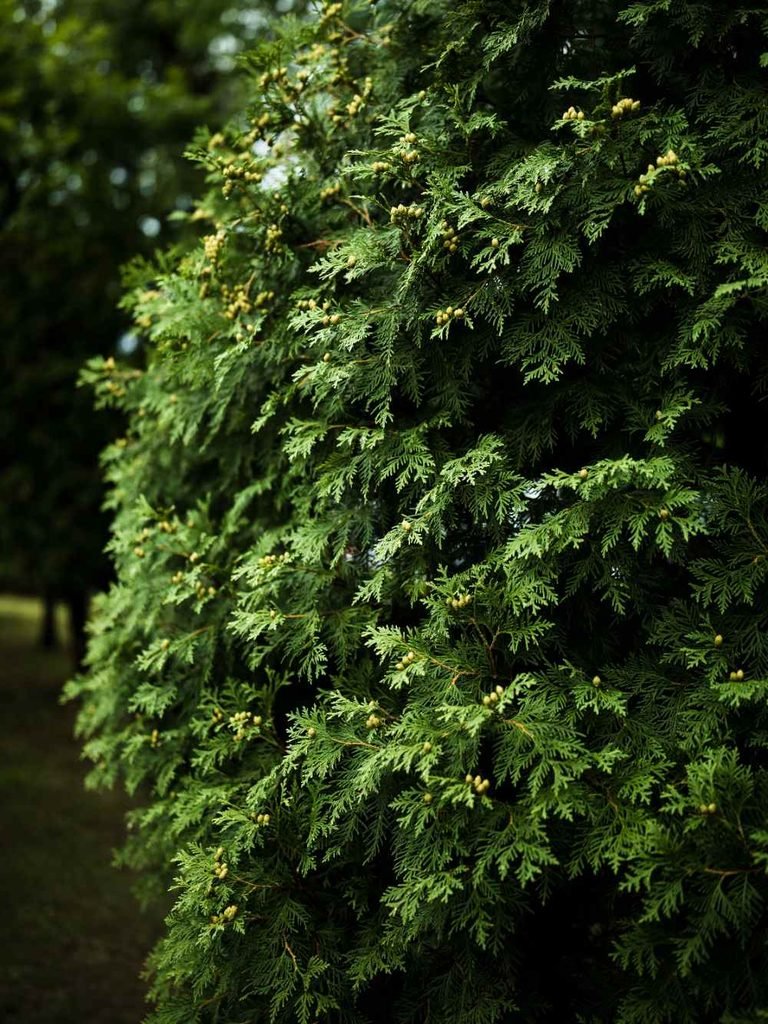
Thuja plicata ‘Spring Grove’ (also sold under the cultivar name ‘Grove’) is a selected form of Western red cedar chosen specifically for its cold hardiness and heavy deer resistance. It performs exceptionally well across USDA hardiness zones 5 through 8.
Spring Grove displays a tight pyramidal growth habit, reaching heights of 25 to 35 feet with a mature width of 8 to 12 feet. Its glossy, dark green foliage does not yellow or brown out in harsh winter winds.
Because this cultivar maintains high concentrations of natural repellent terpenes, it rarely experiences browsing damage unless deer herds are facing extreme winter starvation. It makes an excellent alternative to Emerald Green for gardeners who want a classic conical evergreen screen.
Zebrina Arborvitae
Thuja plicata ‘Zebrina’ is an eye-catching variegated Western red cedar that brings unique ornamental value to the garden alongside proven deer resistance. Its branch tips feature alternating bands of bright golden-yellow and rich forest green.
Zebrina develops a broad, conical form that reaches heights between 30 and 40 feet over several decades, though it can be maintained at smaller dimensions through careful annual trimming. It produces aromatic foliage that deer consistently avoid.
This cultivar thrives in full sun to partial shade and prefers moist, fertile, well-drained soil. It works equally well as a dramatic standalone focal specimen or as part of a mixed evergreen border designed to resist wildlife browsing.
Can-Can Western Red Cedar
For gardeners with smaller yards or tight residential spaces, Thuja plicata ‘Can-Can’ serves as a compact, dwarf solution that still provides the deer resistance of Western red cedar. It grows slowly, reaching a manageable height of roughly 7 to 8 feet and a width of 4 to 5 feet over ten years.
Can-Can features dense, dark green foliage with bright creamy-yellow tips on fresh spring growth. This striking two-tone coloration creates visual depth in foundation plantings, patio borders, and small privacy groupings.
Because it retains the chemical profile of full-sized Western red cedars, deer typically leave Can-Can alone. Its compact stature also makes it easy to spray or enclose if local deer pressure becomes unusually intense.
Using Deer Repellents Effectively
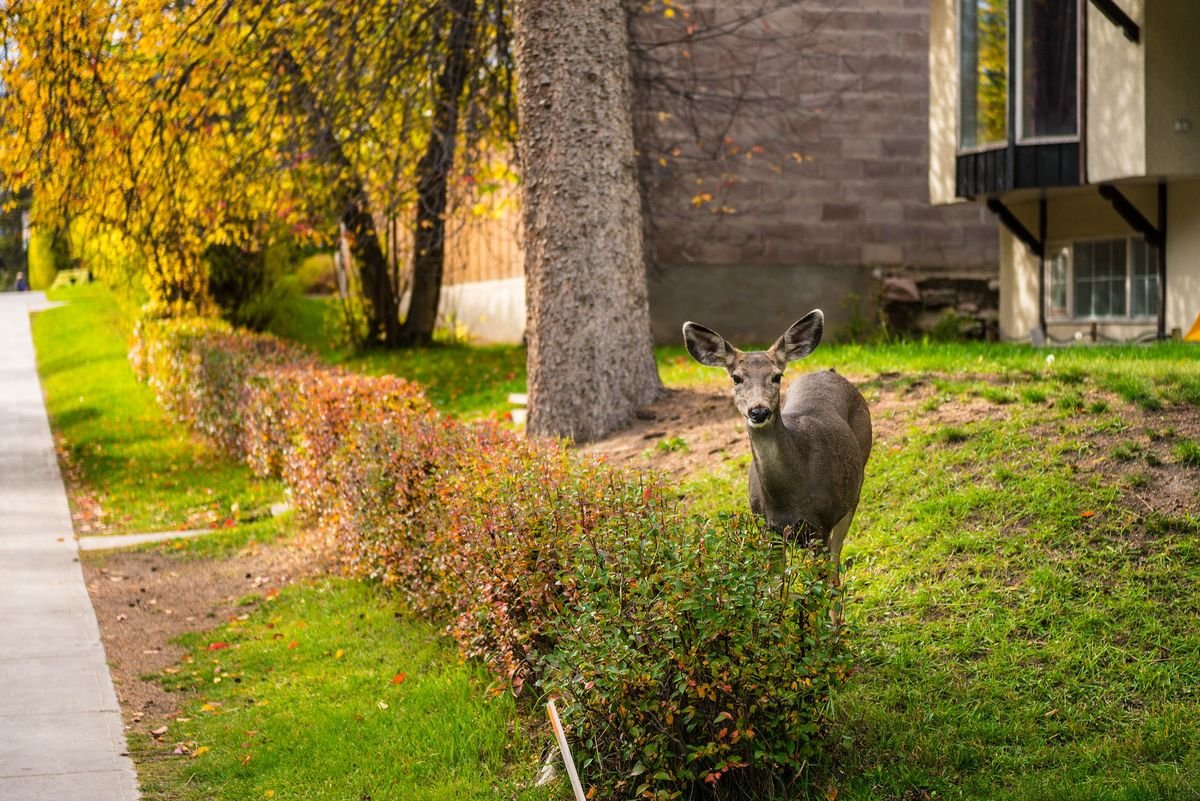
Chemical and scent-based repellents can successfully protect vulnerable arborvitae, but their success depends on proper application technique and consistency. Repellents work through two main mechanisms: offensive scent or bitter taste.
Scent-based repellents rely on ingredients such as putrescent whole egg solids, dried blood, or garlic oil. These odors trigger a natural fear response in deer by mimicking the scent of predators or decaying organic matter. Taste-based repellents incorporate capsaicin, bittering agents, or essential oils that make foliage intensely unpleasant to chew.
To keep repellents effective throughout the year, follow these practical guidelines:
- Apply sprays during dry weather when temperatures remain above freezing so the liquid adheres to the needles.
- Rotate between two or three different repellent formulations every couple of months to prevent deer from becoming accustomed to one specific scent.
- Reapply treatments every four to six weeks, or immediately following heavy rain or melting snowstorms.
- Focus applications heavily on the lower six feet of the trees, paying extra attention to fresh, soft spring tips.
Installing Physical Netting and Burlap
When deer populations are dense and winter foraging is aggressive, physical barriers provide a foolproof method of protecting vulnerable arborvitae foliage. Wrapping trees prevents deer from accessing foliage and offers valuable protection against drying winter winds.
Heavyweight polypropylene mesh netting or standard horticultural burlap are the most common barrier materials. Netting allows sunlight and airflow to reach the plant while physically blocking deer teeth from reaching tender needles.
To wrap your arborvitae correctly:
- Drive sturdy wooden stakes or metal T-posts into the ground roughly six to twelve inches outside the branch spread.
- Fasten the burlap or mesh securely to the exterior posts rather than wrapping the fabric tightly against the needles.
- Ensure the barrier extends at least six to seven feet high to account for deer standing on snowpacks.
- Secure the bottom edge close to the ground using landscape staples so deer cannot push underneath.
Wrapping barriers around external stakes prevents branches from breaking under snow accumulation and eliminates friction damage against delicate branch tips.
Setting Up Proper Deer Fencing
Enclosing your property or planting beds with perimeter deer fencing is the single most effective permanent defense against deer damage. White-tailed deer possess impressive leaping ability and can clear standard four-foot or five-foot garden fences with ease.
An effective deer fence must stand at least seven and a half to eight feet tall. High-strength black polypropylene mesh fencing is a popular option because it blends into wooded backgrounds, resists weather degradation, and costs significantly less than traditional wood or metal enclosures.
For high-pressure corridors, high-tensile wire fencing or angled fencing systems create depth perception challenges that discourage deer from jumping. Keep in mind that deer have poor three-dimensional vision and hesitate to leap into areas where they cannot clearly see a safe landing zone.
Adding Motion Activated Deterrents
Automated deterrents use sudden sensory stimuli to startle deer and teach them that your yard is an unsafe foraging zone. These devices are particularly useful along known deer entry pathways and landscape margins.
Motion-activated sprinklers connect directly to garden hoses and shoot sudden, high-pressure bursts of water whenever movement is detected within their sensor range. They provide an immediate physical and visual shock that quickly sends deer running. Note that sprinklers must be drained and stored before winter freezes arrive.
Ultrasonic sound generators and flashing strobe units offer a winter-ready alternative. These units activate upon sensing infrared body heat, emitting variable high-frequency sounds and disorienting light patterns. Relocate electronic deterrents every two to three weeks so deer do not learn to ignore them as harmless background features.
Assessing Browsing Damage

Recognizing deer damage early helps you take fast corrective action before trees suffer permanent structural failure. Deer lack upper incisors, which forces them to tear and shred plant tissue rather than making clean, angled cuts like rabbits or rodents.
Browsed arborvitae branches exhibit ragged, frayed branch tips. The most obvious sign of heavy deer activity is the classic browse line, where every green shoot and needle is stripped clean from the ground up to roughly five or six feet high.
Because arborvitae foliage rarely regenerates from old, bare interior wood (often called the dead zone), extensive feeding that removes all green needles down to woody stems leaves permanent bare patches. If some green scale foliage remains along the stripped branches, the plant retains the cellular capacity to push new growth over time.
How to Help Damaged Trees Recover
If your arborvitae have suffered winter browsing, prompt spring care can stimulate recovery and encourage remaining dormant buds to break. The goal is to maximize vegetative growth during the active spring and early summer growing window.
Begin by lightly pruning away ragged, splintered branch tips using sharp, sterilized bypass hand pruners. Make clean cuts just above the nearest green growth junction to help the wound seal quickly and prevent fungal spores from invading the injured stems.
Apply a balanced, slow-release granular fertilizer formulated for acid-loving evergreens in early spring as new growth begins. A formula containing nitrogen, phosphorus, potassium, and micronutrients supports rapid foliage synthesis.
Maintain consistent soil moisture throughout the summer months. An established arborvitae recovering from stress needs deep, slow watering once a week during dry spells, delivering roughly one to two inches of water straight to the root zone.
Soil and Watering Requirements
Arborvitae perform best when grown in moist, well-draining soils with a neutral to slightly acidic pH range between 6.0 and 7.5. They tolerate various soil textures, from sandy loams to heavier clays, provided water does not pool stagnantly around the root collar.
Proper root development plays a critical role in tree vigor and pest resistance. When planting new arborvitae, dig a hole twice as wide as the root ball but equal in depth to ensure the root flare sits slightly above surrounding soil grade.
Apply a three-inch layer of organic mulch, such as shredded bark or wood chips, over the root zone out to the drip line. Keep the mulch three inches away from the trunk base to prevent bark rot and rodent nesting. Mulch regulates soil temperature, slows moisture evaporation, and reduces weed competition.
Preventing Winter Burn and Desiccation
Gardeners sometimes mistake winter burn for deer damage because both problems result in brown, dead foliage in late winter and early spring. Winter burn occurs when dry winter winds and bright sun cause foliage to lose moisture through transpiration while frozen soil prevents roots from taking up replacement water.
Unlike deer damage, which leaves stripped stems and jagged branch tips, winter burn leaves dead, rust-brown needles firmly attached to the tree. The southern and western sides of the tree usually show the worst symptoms because they receive the strongest winter sun exposure.
To prevent winter desiccation:
- Hydrate your arborvitae thoroughly in late autumn before the ground freezes solid.
- Maintain a thick layer of root mulch to insulate soil and keep moisture accessible longer into the season.
- Erect burlap windbreaks on the windward side of exposed trees to block drying winter gales.
- Apply an anti-desiccant spray in late November or early December to coat foliage with a temporary protective wax film.
Controlling Other Common Pests and Diseases
While deer represent the most destructive mammalian threat to arborvitae, several insect pests and fungal pathogens can weaken trees and leave them vulnerable to secondary stress. Regular monitoring allows for early detection and targeted management.
Bagworms are caterpillar pests that construct spindle-shaped bags out of silk and arborvitae needles. These bags hang from twigs like miniature pinecones. Heavy bagworm infestations can defoliate entire trees within weeks. Handpick and destroy bags in late autumn or treat young larvae with Bacillus thuringiensis (Bt) in early summer.
Spider mites thrive during hot, dry summer weather. They puncture foliage cells to suck plant juices, causing needles to develop a stippled, dusty, yellowed appearance with fine webbing between twigs. Spraying trees with strong water jets or applying insecticidal soap eliminates mite populations.
Tip blight and root rot fungi occasionally strike arborvitae planted in poorly drained soil or dense shade. Ensure adequate spacing between trees to promote rapid air circulation, avoid overhead sprinkler irrigation, and plant only in well-drained locations to keep root systems vigorous.
Assess Your Arborvitae Deer Risk Level
Answer 4 quick questions to see your result